Ásanas
“Ásana” means “a position in which one feels comfortable” –
“Sthirasukhamásanam.” Ásanas are a kind of exercise by regular
practice of which the body stays healthy and hardy and many diseases are
cured. But ásanas are not prescribed for the general cure of diseases;
only those diseases which create trouble in the path of meditation may
be cured by the help of specific ásanas, so that sádhaná may more
easily be done.
The relation between the physical body and the mind is very close.
Mental expression is brought about through the vrttis, and the
predominance of the vrttis depends on different glands of the body.
There are many glands in the body and from each there is a secretion of
a particular hormone. If there is any defect in the secretion of
hormones or any defect in a gland, certain vrttis become excited. For
this reason, we find that in spite of having a sincere desire to follow
the moral code, many persons cannot do so; they understand that they
should do meditation, but they cannot concentrate their minds because
their minds become extroverted due to the external excitement of this or
that propensity. If a person wants to control the excitement of these
propensities, he or she must rectify the defects of the glands. Ásanas
help the sádhaka to a large extent in this task, so ásanas are an
important part of sádhaná.
A list of ásanas is given below. The same ásanas are not necessary for
everyone. There are more than 50,000 ásanas; among them a few are named
here which are most necessary for the path of meditation. The ácárya
will teach particular ásanas to a person according to his or her need.
There are many ásanas whose forms are similar to those of different
animals, and therefore they are called by the names of those animals.
And there are many characteristics found in animals and birds which are
not commonly found in human beings: the physical structures of those
animals and birds are such as to further certain glandular secretions,
and as a result certain special qualities are developed.
The tortoise can easily retract its extremities. If human beings can
also sit in that way for some time, they can withdraw their minds from
the external world. The name of that posture is kúrmakásana (tortoise
posture).
Rules for ásanas:
(1) Before practising ásanas, do vyápaka shaoca or take a full bath.
Vyápaka shaoca must also be done before daily meditation; if ásanas
are done with daily meditation then it is not necessary to do vyápaka
shaoca separately.
(2) Do not practise ásanas in an open place, because it may result in
sudden exposure and thereby you may catch cold. While practising ásanas
indoors, attention should be paid to keep the windows open so that air
can pass through.
(3) No smoke should be allowed to enter the room. The less smoke the
better.
(4) Males must wear a Kaopiina (laungot́á), and there should be no
other clothing on the body. Females must wear tight-fitting underwear
and a bra.
(5) Practise ásanas on a blanket or a mat. Do not do ásanas on the
bare ground, because you may catch cold, and some secretions which come
from the body while practising ásanas may be destroyed.
(6) Practise ásanas only while breath is flowing through the left
nostril or both nostrils; do not practise ásanas when the breath flows
only through the right nostril.
(7) Take sáttvika food. But a person for whom it is difficult to give
up rájasika food can for the time being take a small piece of myrobalan
(it is better to use the small type of myrobalan), or something of a
similar nature, after meals. However, this procedure does not apply in
cold countries.
(8) Do not cut the hair of the joints of the body.
(9) The nails of the fingers and toes must be kept cut short.
(10) Do not practise ásanas on a full belly. It is prohibited to
perform ásanas for two-and-a-half to three hours after a meal.
(11) After practising ásanas, you should massage your arms, legs and
entire body, especially the joints, very well.
(12) After the massage is finished, remain in shavásana (corpse
posture) for at least two minutes.
(13) After shavásana do not come in direct contact with water for at
least ten minutes.
(14) A practitioner of ásanas should not massage his or her body with
oil. If you like you may rub oil lightly over the body.
(15) After practising ásanas, it is desirable to walk in a solitary
place for some time.
(16) Just after ásanas práńáyáma is prohibited.
(17) If it is necessary to go outdoors after practising ásanas and if
at that time the body temperature has not come down to a normal level,
or if there is any difference between the room temperature and the
outside temperature, you must cover your body when going out. If
possible, inhale a deep breath inside the room and exhale it after
coming outside. In that way there will be no chance of catching cold.
(18) It is not prohibited for the practitioner of ásanas to practise
free-hand exercise, running or sports, but just after ásanas all these
are prohibited.
(19) There is no restriction of nostril for the following ásanas:
padmásana (lotus posture), siddhásana (siddha posture),
ardhasiddhásana (half siddha posture), bhojanásana (cross-legged
sitting posture), viirásana (viira posture), diirgha prańáma (long
bowing posture), yogásana (yoga posture) and bhújauṋgásana (snake
posture).
(20) For all those ásanas where there is no restriction of nostrils,
there is no restriction on food either.
(21) During menstruation, pregnancy and within one month of delivery,
women must not practise ásanas or any other exercise. The ásanas for
dhyána can be done under all conditions – padmásana, siddhásana and
viirásana are the proper ásanas for dhyána and dhárańá.
No one should risk harm by practising ásanas and mudrás without the
supervision and advice of an ácárya [yoga spiritual teacher].
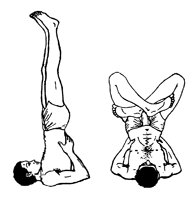
(1) Sarváuṋgásana (all-limbs posture):
(a) Lie down on your back. Gradually raise the entire body and keep it
straight, resting its weight on your shoulders. The chin must be in
contact with the chest. Support both sides of your trunk with your
hands. The toes must remain together; the eyes must be directed at the
toes.
(b) Lie down in padmásana. Gradually raise the body and rest its weight
on your shoulders. Support both sides with the hands. This ásana is
also known as úrdhvapadmásana (inverted lotus posture).
Practise three times, up to five minutes each time.
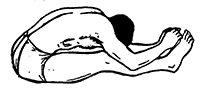
(8) Utkat́a pashcimottánásana (difficult back-upwards posture): Lie in
a supine position and extend the arms backwards, keeping them close to
the ears. Rise while exhaling and insert the face between the knees.
Make sure that the legs remain straight. Grasp both the big toes with
the hands. Remain in this state for eight seconds. Now resume the
original posture while inhaling. Practise eight times in this way.
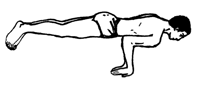
(16) Mayúrásana (peacock posture): Assume a squatting position. Bring
the wrists together and place the palms on the floor, with the fingers
pointing towards the feet. Now bring the elbows in contact with the
navel and stretch the legs backward. Supporting the weight on the
elbows, raise the head and the legs from the floor. Duration – half a
minute. Practise four times.
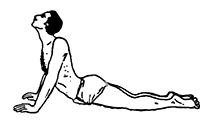
(20) Bhújauṋgásana (snake posture): Lie down on your chest.
Supporting the weight on the palms, raise the chest, directing your head
backward. Look at the ceiling. Breathe in while rising, and after having
risen, hold your breath for eight seconds. Come down to original
position while breathing out. Practise eight times.
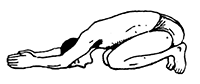
(25) Ardhakurmakásana (half tortoise posture) or
diirgha prańáma
(long bowing posture): Kneel down, and holding the palms together,
extend the arms upward, keeping them close to the ears. Then bend
forward in a posture of bowing down, touching the floor with the tip of
the nose and the forehead. The buttocks must continue to touch the
heels. While bending down breathe out and stay in a state of complete
exhalation for eight seconds. Then rise up, breathing in. Practise eight
times.
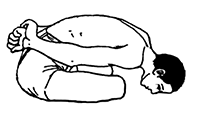
(26) Yogásana or yogamudrá (yoga posture): Sit in bhojanásana. Pass
both hands backward and grip the left wrist with the right hand. Then
bring the forehead and the nose into contact with the floor, breathing
out during the process. Maintain this state for eight seconds and then
rise up, breathing in. Practise eight times.
(31) Utkat́a vajrásana (difficult thunder posture): Lie down in
vajrásana. Place the arms as in matsyásana. Duration – half a minute.
Practise three times.
(32) Padahastásana (arm-and-leg posture): Stand erect, raising the
arms, palms open. Then bend the trunk and the left arm leftwards while
breathing out, and in a state of full expiration touch the left foot
with the left hand. After maintaining this position for eight seconds,
raise the body and extend the left arm upwards, breathing in throughout
the process. When the body is perfectly erect again, bend the trunk and
the right arm rightwards, breathing out, and, in a state of complete
expiration, hold for eight seconds, touching the right foot with the
right hand. Then raise the trunk, extending the right arm upwards,
inhaling throughout the process. Then bend the trunk forward, breathing
out in the process, and catch hold of the big toes. Stay in this
position for eight seconds. Then, breathing in, rise up, and raise the
arms and extend them backward. When you cannot bend any farther back,
hold yourself in that position for eight seconds, retaining the breath.
Then bend forward while breathing out, and, just touching the big toes
(i.e., without staying in that position), raise the trunk and the arms,
breathing in. One round is then complete. Practise eight rounds, making
sure that no part of the body below the waist is bent at any time.

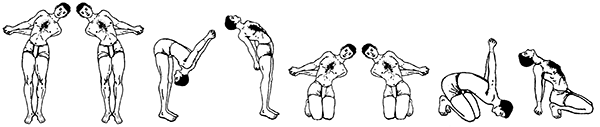
(35) Karmásana (action posture): This ásana is made up of two parts.
The second part is the complement of the first. One performance of the
first and second parts makes a complete round. Four rounds should be
practised.
First Part
Stand upright, and placing both hands behind the back, interlock the
fingers and press the palms together. Keeping the body below the navel
steady, move the upper body in four directions as in padahastásana.
(i) Bend the upper part of the body leftwards, breathing out, and stay
in this position for eight seconds, holding the breath. Resume original
position, breathing in. Move the interlocked hands to the right when the
body bends leftwards. Remember that the left arm should touch the back
when the body is bent, and keep touching it while holding this position.
(ii) Practise similarly on the other side, that is, bend the upper part
of the body to the right and move the interlocked hands to the left.
(iii) Bend downward exhaling slowly. As you bend lower and lower,
gradually raise the interlocked hands upwards. Bring the head as low as
possible and raise the arms upwards with the hands interlocked. The
knees should not bend. Maintain this position for eight seconds without
inhaling. Resume original position, inhaling.
(iv) Bend the upper part of the body backwards while inhaling. While
bending the trunk, head and neck backwards, hold the interlocked hands
straight down. Stay in this position, holding the breath, for eight
seconds. Breathing out, resume original position.
Second Part
In the first part of karmásana you do the ásana standing, while in the
second part you kneel down and sit on the heels. Then repeat the same
exercise as in the first part, moving the body in all four directions.
The toes should point forwards. The duration and manner of breathing
should be the same as in the first part. In this part also the body
below the navel should not bend. The second part differs from the first
part as follows:
(i) and (ii) are no different from the first part.
(iii) – While bending forwards, the nose and forehead should touch the
ground.
(iv) – while bending the chest and head backwards, the interlocked hands
should graze the soles of the feet and touch the ground, supporting the
weight a little.